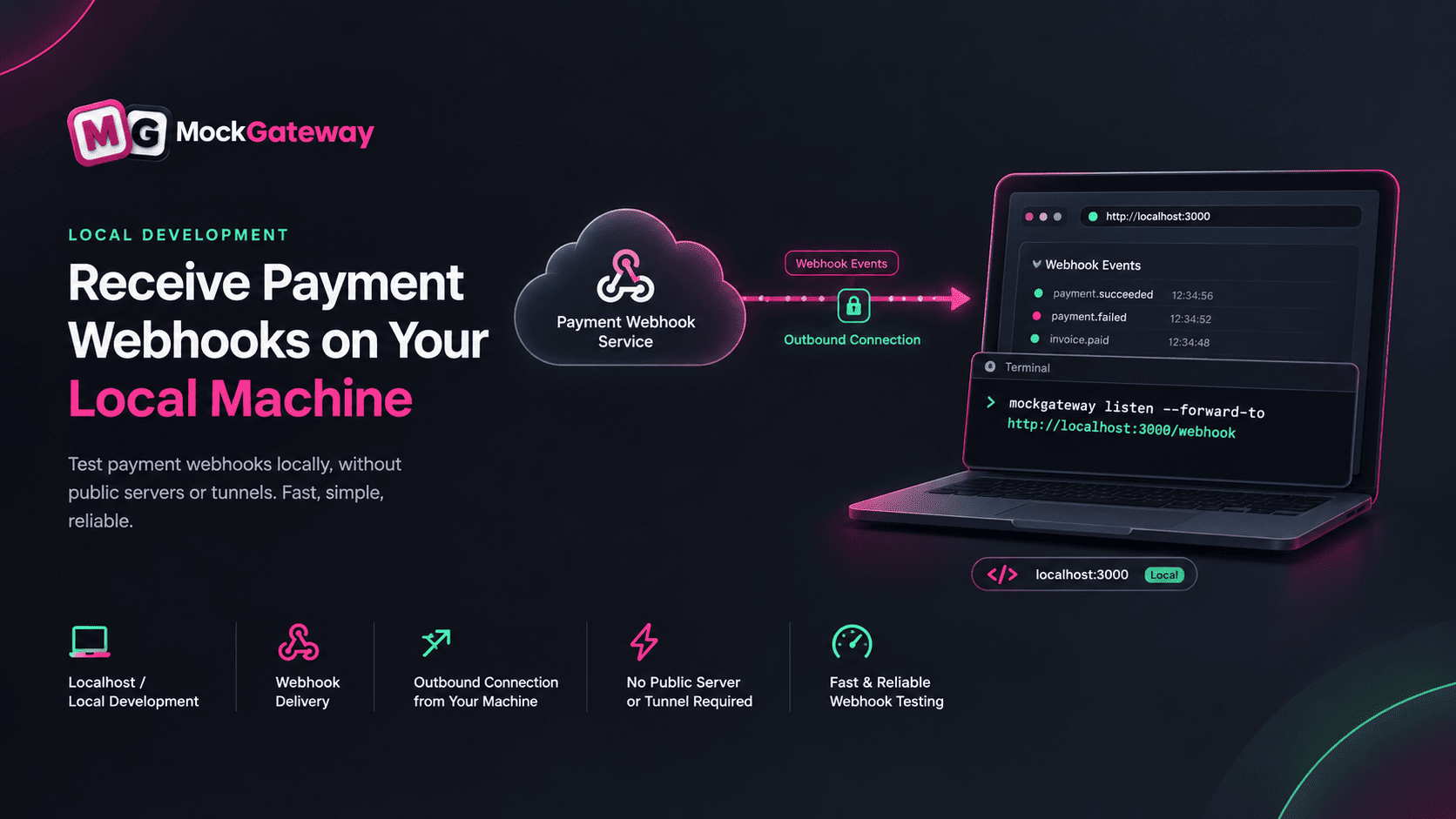
You're building a checkout flow but the gateway isn't ready yet. No API keys. No sandbox access. The client is still setting up their account and you're just... waiting. This is one of the most common delays in payment development — and it's completely avoidable.
What does "simulating a payment gateway" actually mean?
It means running a fake gateway that acts like a real one. You send it a payment request, it redirects the user to a checkout page. The user picks an outcome — success, declined, expired card — and your server gets back a proper response. Webhooks fire to your registered URL. Everything behaves exactly like a live gateway would, just without a real bank behind it.
You can test the same flow twenty times in a row, try every failure scenario, and never worry about side effects or charges.
Who actually needs this?
More people than you'd think. If you're a freelancer, your client's gateway account is probably still being reviewed while you're trying to hit a deadline. If you're on a product team, you might be comparing Stripe vs. Razorpay and don't want to build two full integrations just to evaluate them. And if you run CI pipelines, you already know how unreliable external sandboxes are — they go down, they rate-limit, and suddenly your tests are failing for no reason.
In all of these cases, a local simulator keeps you moving without depending on anyone else.
How would you build one yourself?
Keep it as a separate project or module — don't mix gateway logic into your main app. You need four pieces: an init endpoint that accepts a payment request and returns a redirect URL, a checkout page with an outcome picker instead of a real card form, a verify endpoint that returns a full transaction record, and a webhook dispatcher with proper signature headers.
Make sure the response format matches the real provider you'll use later. If it doesn't, you'll be rewriting your integration code the week before launch. Done right, it's about a week of work to build something solid.
How to skip the build and start in under a minute
MockGateway's playground lets you simulate a payment gateway instantly — no account, no setup. Pick a provider template (Stripe, PayPal, Razorpay, and more), paste the endpoint URL into your app, and start testing right away.
The response format already matches the real provider. The checkout page has an outcome picker. Webhooks are delivered once to the configured endpoint. Run a new test payment to produce a new event. When your real credentials are finally ready, just swap the base URL and API key. Your integration code stays exactly the same.
Tagged with
Found this helpful?
Share it with your network.